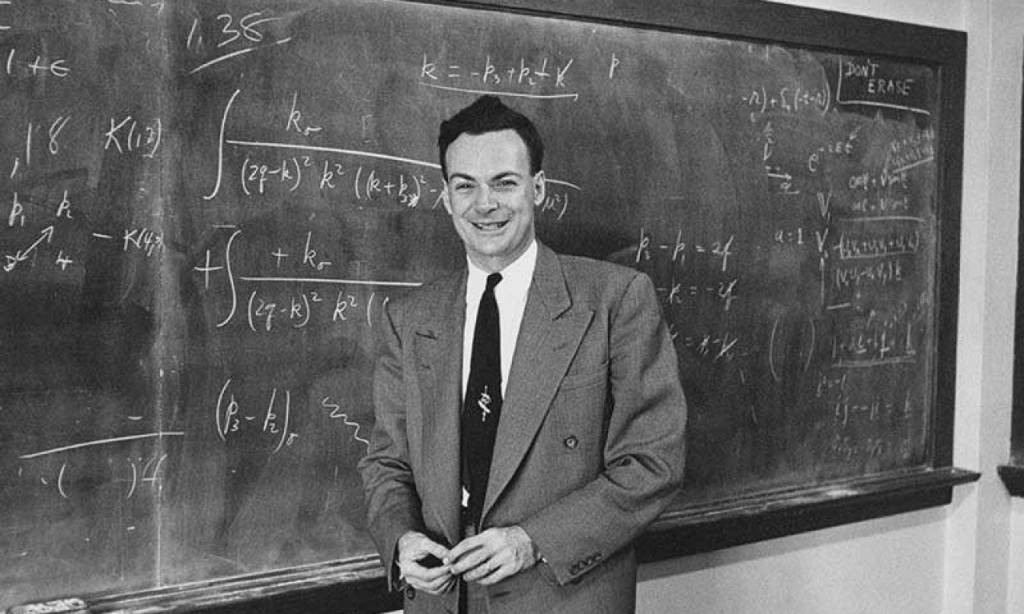
Note: Skip down to My Outtakes on Richard Feynman’s Lectures on Physics if you’re not interested in my introductory ramblings on science communication.
Another note: I don’t want to make it seem as if I’m a typical Feynman bro with this post. There will be a lot of praise for Feynman here, but I want to state publicly that I denounce any discriminatory/creepy treatment towards women (or generally anyone). Richard Feynman was a brilliant physicist, but it’s important to make it clear that you should NOT treat a member of a gender, class, or race as lesser just based on that membership alone. Okay, that’s all! Enjoy!
Science Communication is Necessary
The topic of science communication is a niche one, to be sure. Google Gemini’s AI Overview (yeah, that’s where we are now) of science communication goes as follows:
> Science communication, also known as “sci-comm”, is the practice of educating and raising awareness about science-related topics with non-specialists.
I like the open-ended nature of this definition. I mean, communication is simply the act of relaying ideas from a source to a destination audience. Science communication is not much different; in fact, to get a workable definition, I’d simply alter the previous sentence like so: “[science] communication is simply the act of relaying [scientific] ideas from a source to a destination audience.” Now, there is more to be said about the danger of disinformation or perpetuating common misconceptions, but for the purposes of this post, that’s generally the definition I’m keeping in mind while I’m writing.
At the end of the day, while the scientists are pushing the frontier of humanity forward, there needs to be people who can relay the outstanding progress to the common folk. In my opinion, if outsiders are kept unaware, it fuels ridiculous conspiracies, like the Flat Earth and Electric Universe “theories”, and not to mention the more competent folks who are able to sell much more convincing theories like Deistic Creationism. Whether it be through a lecture in a dimly lit university auditorium or through some self-indulgent, science-loving, twenty-something year old’s blog, more science communication only serves to benefit the world as long as care is taken when trying to relay facts.
Science Communication is Difficult
It’s no secret that communicating science to the general populous proves to be a serious challenge. In my uneducated experience, the one thing that a communicator can hope for is to have an audience that is moderately science-literate. The toughest hurdle I’ve faced in the times I’ve tried to explain more scientific topics like Boltzmann Machines or my understanding of Einstein’s relativity, or even things like the system design of my start up, has been communicating these things to layfolk. The subsequent reaction to my attempt can take various forms, such as:
- Eyes glazing over
- Eyes crossing
- Eyes squinting in anger or mild hatred
- Eyes closed (totally not sleeping, just really taking it in)
Needless to say, lots of different eyes directed towards me, generally negative in nature. “Now, Davian,” you must be wondering, “why not just stop interjecting scientific topics into your late-night hangouts with friends who are most likely inebriated and not at all interested in topics you bring up?”
No. 😃
Call me insufferable, but I think that those late nights discussing things that really interest me have been some of the most invigorating moments of my life. Perhaps I could be harshing the proverbial mellow, but I still have friends, so I consider that an invitation to continue! Those warm, gooey feelings I feel in the rare moment someone looks at me and actually understands a cool fact or interesting theory I’m explaining leads me to believe that science communication could be something I’m really passionate about.
Needless to say, I have some glaring weaknesses that I need to tidy up: knowing my audience, simplification of ideas, and just general verbal communication. I tend to talk fast when I get excited and, 9 times out of 10, it ruins the message I’m trying to convey. Luckily, I consider myself a much better writer than orator, so with that, let’s finally go over some realizations I’ve made from my readings over the week.
My Outtakes from Richard Feynman’s Lectures on Physics
What I Covered
I believe I’ve settled on the final format of this section. First, I’m going to introduce any background knowledge that’s necessary for the source I’m reading – which will be less necessary as I start reading longer form texts – then I’ll give a digestible summary of the notes I took. If you have any feedback, let me know, but for now, let’s get on with the background.
For those who don’t know, Richard Feynman, a Nobel prize winning physicist, was a world-class professor at Cal Tech and Cal Tech has graciously made his lectures on Physics public here. Over this busy Thanksgiving week, I was able to get in the first two chapters of Volume II where Feynman goes over, in broad strokes, the history of Physics progress before and after 1920 and also some general information about atoms and their physical interactions with the world. Here’s a brief summary of my notes:
> The Feynman Lectures explore the fundamental principles of physics, including the behavior of atoms and the relationship between electric and magnetic forces. Quantum mechanics introduces the concept of uncertainty, which asserts that both the position and momentum of particles cannot be known with 100% confidence. Despite the success of quantum theory in explaining various phenomena, it still faces challenges in unifying macroscopic and microscopic phenomena, particularly in nuclear and gravitational physics.
What I Took Away
Frankly, this week was more of a warm-up week to whet my appetite for the coming studying I’m going to be doing. For that reason, I wanted to pick a text that I know will not only be insightful, but inspirational, and I believe that goal was achieved. In my opinion, Feynman is an expert communicator of Physics. In his lectures, he is charismatic and funny, yet leaves no doubt that he is a very intelligent man with a mastery of his field.
Despite the fact that much of what I read in these chapters was a review of my Physics I and II courses, I still came away with fascinating insights regarding the history and significance of the 19th and 20th centuries’ discoveries in Physics. I would recommend to anyone with an interest in Physics to read through these lectures on their own time; it will certainly not be a waste. I’m personally going to read one more chapter before moving on to a more rigorous text, but I will certainly return to these lectures from time to time throughout my journey.
With that, I leave you, my humble reader. I hope this post was at least somewhat enjoyable for you; I know writing it was certainly a blast.
Signing off,
Davian
 DVN
DVN 
Leave a comment